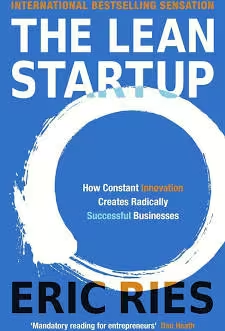
In The Lean Startup, Eric Ries challenges the conventional belief that startups need a perfect product and an elaborate business plan before entering the market. Instead, he argues that successful businesses are built through continuous experimentation, customer feedback, and rapid adaptation. The book introduces a practical framework that helps entrepreneurs minimize risk while maximizing learning, making it one of the most influential books on modern entrepreneurship.
At the heart of the book is the concept of the Minimum Viable Product (MVP)- the simplest version of a product that can be launched to test assumptions and gather real customer feedback. Rather than spending months developing a feature-rich product, startups are encouraged to release an early version, observe how users respond, and refine the offering based on actual market demand. This approach reduces wasted time, effort, and capital.
Ries also introduces the Build-Measure-Learn feedback loop, which serves as the foundation of the Lean Startup methodology. Businesses begin by building a product with a specific hypothesis in mind, measure customer interactions through meaningful data, and use those insights to determine the next course of action. This iterative cycle enables startups to make informed decisions instead of relying on assumptions.
Another key idea explored in the book is validated learning- the belief that genuine progress comes from testing hypotheses and understanding customer behavior rather than simply launching products or adding new features. Complementing this is the concept of innovation accounting, which encourages startups to evaluate success through actionable metrics such as customer retention, engagement, and conversion rates instead of vanity metrics like downloads or website traffic.
One of the book’s most valuable lessons is knowing when to pivot and when to persevere. If data consistently shows that a business model or product isn’t working, changing direction is not considered failure but a strategic response to evidence. This mindset helps startups remain agile in uncertain markets while continuously moving toward product-market fit.
More than a startup handbook, The Lean Startup presents a disciplined approach to innovation. Its principles are relevant not only for entrepreneurs but also for product managers, corporate innovators, and organizations looking to develop customer-centric products efficiently. By emphasizing experimentation, evidence-based decision-making, and continuous improvement, Eric Ries provides a blueprint for building sustainable businesses in an increasingly competitive world.
For more such reccomendations, stay tuned to our blog. We promise you- we’ll bring you only the best of the best. #ReadwithGSN